BBK26: Powering the Expedition!
Apr 15, 2026
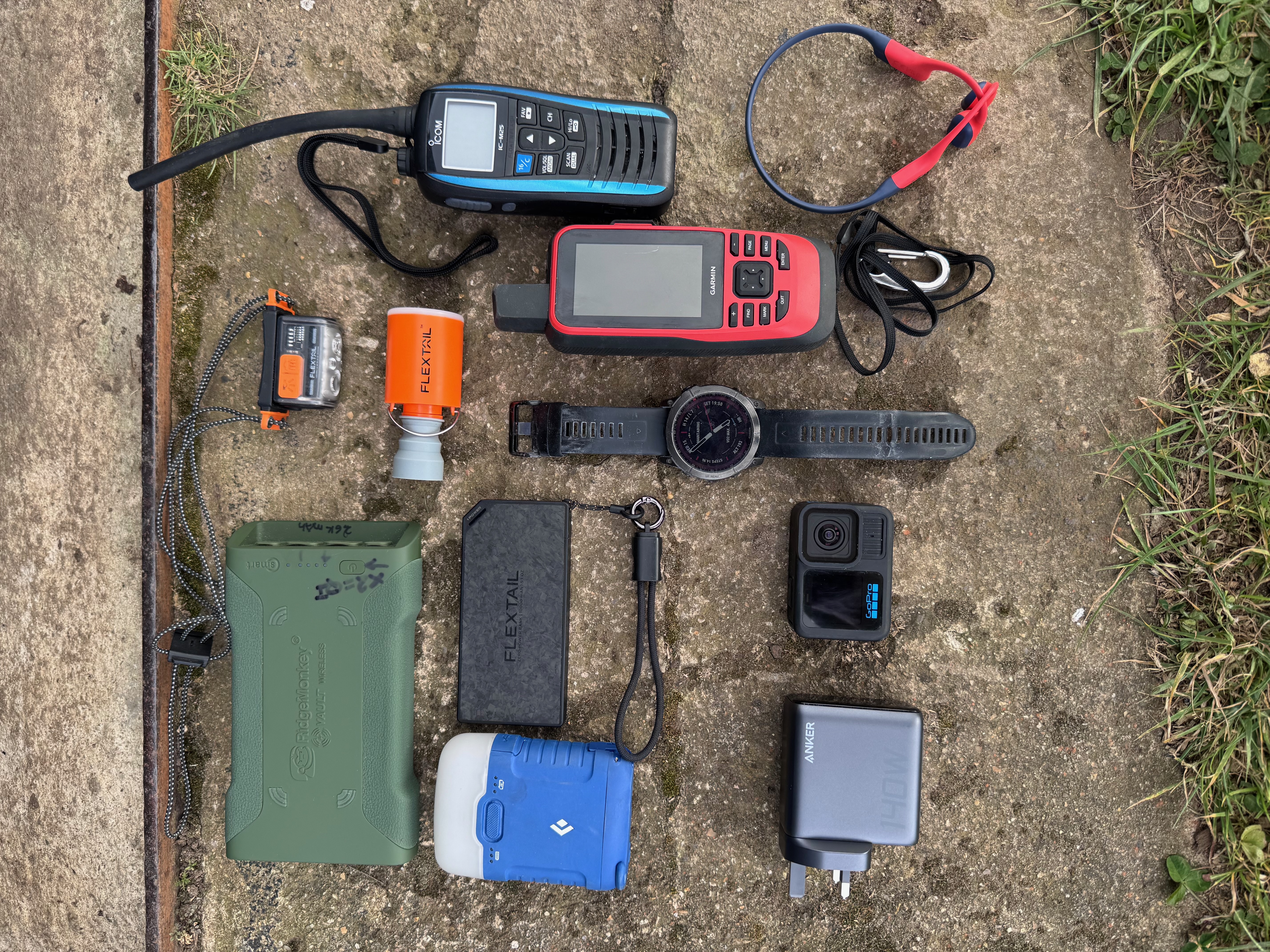
The Reality
Modern expeditions run on electrons as much as calories.
For Britain by Kayak 2026, I’m carrying a small set of essential devices — not for comfort, but for:
- Navigation
- Safety
- Communication
- Recording the journey
But every device adds a simple question:
How do I keep it all powered — reliably — for weeks on end?
This blog sets out:
- What I’m taking
- The power system behind it
- What I learned on a recent mini-expedition in Asturias
- And the simple charging strategy I’ll use around Britain
📱 The Devices
Core expedition electronics
-
Garmin GPSMAP 86i
Primary navigation and tracking device with inReach satellite comms. -
Garmin Fenix 7
Activity tracking, backup navigation, and daily logging. -
iPhone 15 Pro Max
Charts, weather, comms, photos, and content capture.
(Also the camera that took the photo here — which is why it’s missing from the shot.) -
Shokz OpenSwim (Waterproof Bluetooth headphones with 4gb stored music) Not essential — but useful for morale on long solo days.
Supporting kit
- Flextail mini-pump
- Headtorch / tent light (also doubles as a small emergency battery)
- Exposure Raw-Plus Marine Torch and Strobe
🔋 The Power Banks
What I’m carrying
-
RidgeMonkey Vault C-Smart Wireless 26950mAh
Primary energy store (~100Wh class) -
Flextail Zero (~10,000 mAh)
Secondary / backup -
Black Diamond lamp (~2,400 mAh equivalent)
Small but useful final reserve
Why three?
Not about capacity — about resilience:
- One fails → system still works
- One gets wet → backup available
- One runs low → buffer remains
Redundancy without over-complication
⚠️ What I Learned in Asturias
A short mini-expedition in northern Spain was a useful test.
On paper, the system worked.
In practice:
My Garmin barely charged overnight — despite being plugged in for hours.
The issue
- Charging via USB-A → micro-USB
- Garmin auto-powered when connected
- Screen/backlight active
- Net gain: ~5–10% over several hours
Meanwhile:
- iPhone charged perfectly
- Power bank had plenty of capacity
🔧 The Fix (Garmin-Specific)
This was the key learning.
The solution:
- Use a USB data-blocker (charge-only adapter)
- Place it between charger and cable
- Prevents the Garmin seeing a “data connection”
Why this works
Without the data pins:
- The Garmin is less likely to boot fully
- It stays in a low-power charging state
- More of the incoming energy goes into the battery
Plus:
- Short, good-quality cable
- Turn the unit fully off before charging
Result: reliable, predictable charging
This is now a fixed part of the system.
🔌 Shore Power: The Charging System
Charger
- Anker 140W 4-Port GaN Charger
This allows me to charge:
- Power bank
- Phone
- Garmin
- Other devices
All from one socket
How I’ll use it
Short stop (≈1 hour)
Priority:
- Phone
- Garmin
- Power bank
Fast gains first.
Overnight
Everything plugged in:
- USB-C → power bank
- USB-C → phone
- USB-A → Garmin (via data blocker)
- Spare → other devices
☀️ Why I’m NOT Using Solar
This is the question everyone asks.
Short answer:
Because it adds complexity for very little real-world gain.
The reality of solar on a kayak:
- UK weather = inconsistent sunlight
- Panels need constant angle adjustment
- Deck mounting = awkward and vulnerable
- Output often low and unpredictable
In practice:
You rarely get:
- Stable output
- Efficient charging
- Meaningful energy gain day-to-day
The trade-off
Solar adds:
- Cost
- Weight
- Deck clutter
- Another failure point
In return for:
- Marginal, inconsistent charging
My approach instead
- Carry enough stored energy
- Recharge opportunistically (cafés, campsites, harbours)
- Keep the system simple and robust
Reliable beats theoretical
🔋 Off-Grid Strategy
Daily
- Phone + Garmin topped up from main power bank
- Backup bank untouched unless needed
Capacity reality
From testing:
- Garmin: ~30% per day
- iPhone: ~30–40% per day
What that means
~5–7 days autonomy without mains power (conservative)
More in good conditions.
🧠 The System Approach
This isn’t about gadgets.
It’s about a system that works when you’re:
- Tired
- Wet
- Cold
- Making decisions alone
So the rules are simple:
- Prioritise critical devices
- Charge when you can, not when you need to
- Build in redundancy
- Keep it simple
🧭 Final Thought
Power is now part of expedition planning — like food and water.
Ignore it, and it will trip you up.
Overcomplicate it, and it becomes fragile.
Get it right, and it disappears into the background — exactly where it should be.
If you’re planning something similar:
Test your system in the field — not at home.
That’s where the real answers are.