BBK26 - Final weeks - Didn't go to plan!!!
Apr 22, 2026
The Drift Before the Start Line
When Training Doesn’t Break — It Slips
In the months leading up to BBK26, things were going well.
Long paddles were stacking up. Time in the boat was building. I was getting tangibly stronger. Confidence was rising.
On paper, I was doing exactly what I needed to do.
But expeditions and there preparations are rarely undone by one big moment.
More often, they unravel quietly — through small shifts that don’t look like problems at the time.
This is a story about that drift.
The First Crack — Good Work, With a Cost
It started with work at home.
Fencing and landscaping — part of my “to-do” list before heading off. Filling ditches, driving-in fence-posts, hauling rubble and concrete blocks, repetitive, physical effort.
In many ways, it was excellent conditioning:
- full-body strength
- grip endurance
- work capacity
- time on feet
Exactly the sort of “real-world” load that should support an expedition.
But it also carried risk:
- high grip demand
- repetitive impact
- asymmetrical loading
- fatigue layered onto paddling
That’s what triggered the wrist issue.
The Wrist — A Small Injury That Changed Everything
The wrist didn’t feel like a major problem at first.
But it had wider consequences:
- it stopped paddling completely for several days to allow recovery
- when I returned, load was reduced
- I couldn’t complete full core and Pilates routines
- I couldn’t even ride my bike
So it wasn’t just paddling that was affected — it was the entire training system.
And when I did get back on the water:
- grip was altered
- stroke subtly changed
- load shifted through the body
Nothing dramatic — but just enough to move away from clean, repeatable movement and I had to reduce mileages/time in the boat.
The False Positive — Scotland
Then came the Duke of Edinburgh expedition on the River Spey. A wonderful trip in its own right and a good time to test camp-craft but ideally, I wouldn’t have scheduled it that close to departure — but it wasn’t really optional. If I’m honest, I knew beforehand: this could disrupt the rhythm.
On paper, it looked perfect:
- multiple days
- 5–6 hours paddling each day
- expedition environment
But the reality was different.
I was:
- in an open canoe
- on moving water
- supervising rather than driving effort
- stopping frequently
Despite being “on the water”, it was relatively sedentary in training terms, despite moving the heavily laden canoe.
It didn’t build the system in the way my normal kayak training does.
Instead, it added:
- fatigue and poor sleep
- asymmetry
- long periods of sitting and two, 12 hours bus journeys.
The Final Straw — Not Big, Just Bad Timing
The back spasm didn’t come from something dramatic.
It came from timing and another poor decision. After returning from Scotland and its 12 hour bus journey, my son invites us for a family visit to the gold driving range.
The combination of fatigue, prolonged stiffness and the completely different, explosive rotational movement was enough
One swing too many, and the system said “no”. A day later I was sore but paddled anyway. In that days that followed I could barely walk at times.
The Accumulation
Looking back, it’s obvious:
- wrist injury → reduced load and altered movement
- fencing / landscaping work → asymmetry and fatigue
- Scotland → volume without specific adaptation
- travel → stiffness
- golf → unfamiliar explosive load
None of these were catastrophic.
Together, they were.
The Psychological Hit
This was probably the hardest part.
Not the pain — but the shift in mindset.
After months of structured training:
- 4–5 hour paddles were normal
- fatigue was manageable
- progress felt tangible
Then suddenly:
- walking was slow
- movement was restricted and painful
- the expedition felt uncertain
And alongside that:
I realised how much I’d missed the high-intensity work.
Zone 4–5 efforts — the sharp end — had virtually disappeared in recent weeks. While I was intentionally shifting towards more Zone 2 paddling, I was still enjoying at least one zone 4/5 session at the club each week.
That absence matters.
It affects:
- confidence
- sharpness
- sense of capability
The Data Tells the Story (The September metrics are directly after a 4 week bike holiday through France and Spain)
| Metric | Early Block (Sept–Feb) | Recent Block (Mar–Apr) | Interpretation |
|---|---|---|---|
| Resting HR | 39–40 bpm | 49–52 bpm | Increased stress / reduced consistency |
| HRV Status | Mostly balanced | Increasingly unbalanced | Fatigue + disruption |
| VO₂ Max (Garmin) | ~48 | ~44 | Loss of high-intensity stimulus |
| Body Weight | ~83 kg | ~92 kg | Reduced load + lifestyle shift |
| Long Paddle Volume | Regular 3–5 hr | Intermittent | Loss of continuity |
| High Intensity Work | Regular | Minimal | Reduced sharpness |
Not a collapse.
But a clear drift.
The system wasn’t breaking — it was losing rhythm.
The Reset — and the Support That Made It Possible
This is where support matters.
Lisa has been central to getting me moving again.
Not just as a physio, but as someone who:
- understands when to push and when to hold me back
- is specific about what I should do and what I shouldn’t
- scales work progression appropriately
- keeps things grounded
The recovery itself wasn’t dramatic.
It was:
- walking
- gentle movement
- controlled exercises
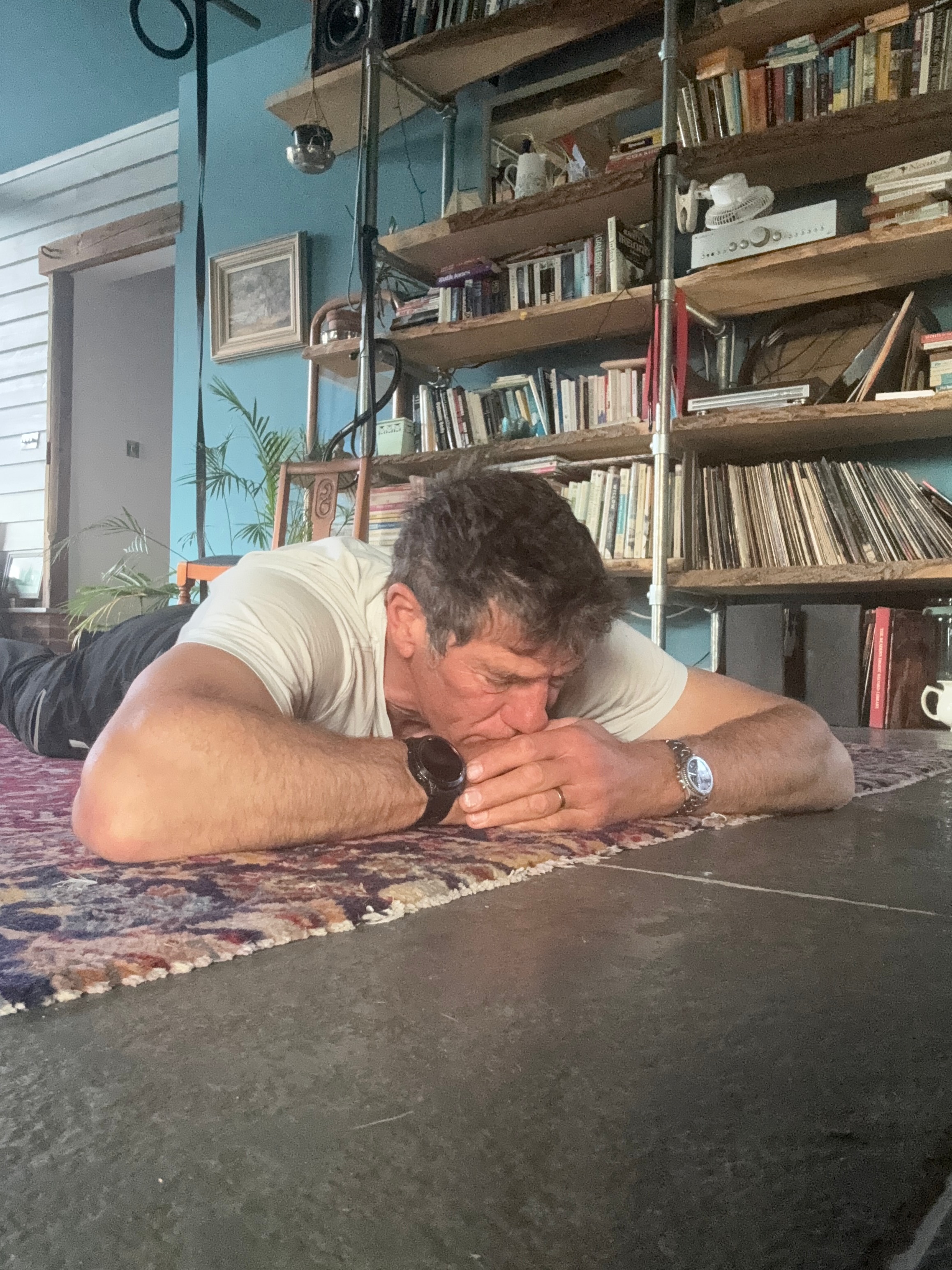
- focussed breathworks - low and slow to mobilize ribs and spine with breaths to accumulate CO2 as a muscle-relaxant.
Plus…patience
And gradually:
- movement returned
- confidence returned
- load tolerance returned
Rethinking Durability
It would be easy to look at this and think:
“My goal of increasing durability hasn’t been achieved.”
But that’s not quite right.
Durability isn’t just about avoiding injury.
It’s about:
- absorbing disruption
- adapting under imperfect conditions
- recovering quickly
The ability to bounce back is itself a form of durability.
The Real Lesson
The takeaway isn’t about one mistake.
It’s about accumulation.
Small disruptions compound.
- a slight injury
- reduced load
- a different stimulus
- fatigue
- stress
Individually manageable.
Together — trajectory changing.
Where This Leaves Me
One week prior to planned departure and I was doubting it would be manageable. I started planning a postponement, looking at tides etc. But my patience paid off and the spasm eased. D-Day minus 6 and I was back to paddling - just one hour but with no consequences. We are back on for 26th April. I’m not “optimal” but I haven’t lost everything.
I’ve lost:
- some sharpness
- some consistency
- some margin
But I still have:
- the aerobic base
- the experience
- the judgement
- the ability to rebuild quickly
And perhaps most importantly:
a clearer understanding of what actually matters going into an expedition.
Final Thought
I didn’t lose my fitness.
I lost my rhythm.
And getting that back — calmly, deliberately, without forcing it —
is what will determine how this expedition begins.